You can't see what your filter is up against. Pollen riding in on the doormat, dust mites working through the carpet, dander that settled weeks ago and never left. A 20x34x4 air filter is the one part of your system standing between that invisible mess and the air your family breathes, and most people choose one off the price sticker alone. We think that's backwards.
After years of making these filters and testing them in real homes, we've learned the best value almost never sits at either end of the price range. It's the filter that fits right, captures what you actually breathe, and keeps working for a full season. When you're ready to line up the best 20x34x4 pleated air filter options by rating, that's the lens to use. And if you want a quick primer on how an air filter works first, start there and come right back.
TL;DR Quick Answers
20x34x4 Air Filters
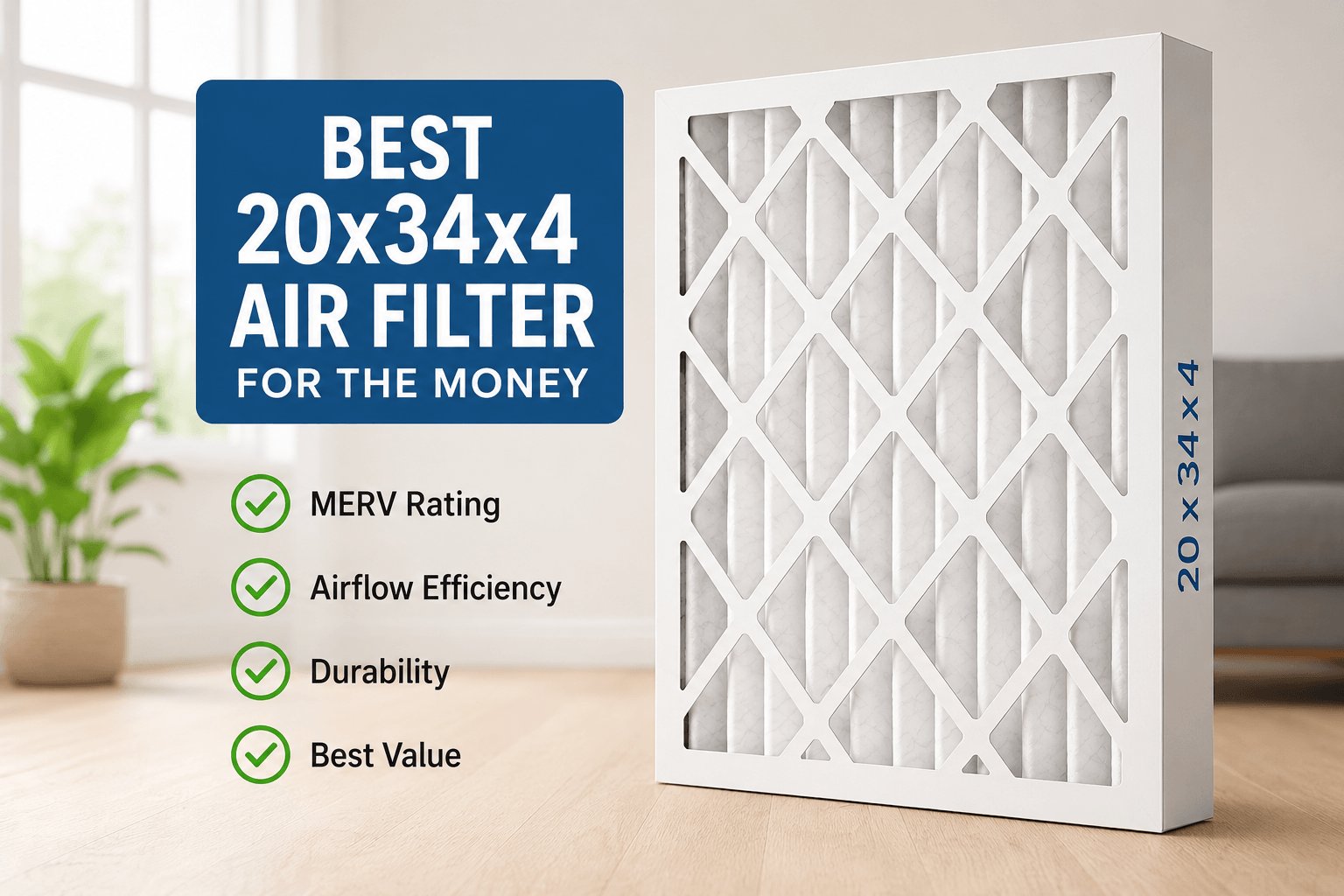
A 20x34x4 air filter is a 4-inch deep pleated filter used in many home furnaces and air handlers. The nominal size is 20 by 34 by 4 inches, while the actual filter runs a little smaller, around 19.5 by 33.5 by 3.63 inches, so it seats cleanly in the slot. The deep pleats hold far more dust than thin fiberglass and keep working for about 90 days.
What we'd tell a neighbor shopping for one:
Fit before features. The filter has to seat with no gaps. Any gap lets air slip past unfiltered, which defeats the point.
Match the rating to your home. MERV 8 handles everyday dust and protects the equipment, MERV 11 suits most homes and pets, and MERV 13 is the pick for allergy or asthma households.
Change it about every 90 days, or closer to every six weeks if you have pets or allergies.
Buy a multipack or set a refill schedule to bring down the cost per filter.
Top Takeaways
Fit first. A nominal 20x34x4 measures about 19.5 by 33.5 by 3.63 inches and has to seat with no gaps.
Match the rating to the household: MERV 8 protects equipment, MERV 11 fits most homes and pets, MERV 13 is the allergy and asthma pick.
Deep pleats carry a filter through the full 90 days. Cheap fiberglass rarely makes it.
Judge value by cost per day of clean air across a year, not by one filter's price.
Shorten the change cycle to about six weeks when allergies are in the picture.
The 20x34x4 Buyer's Checklist
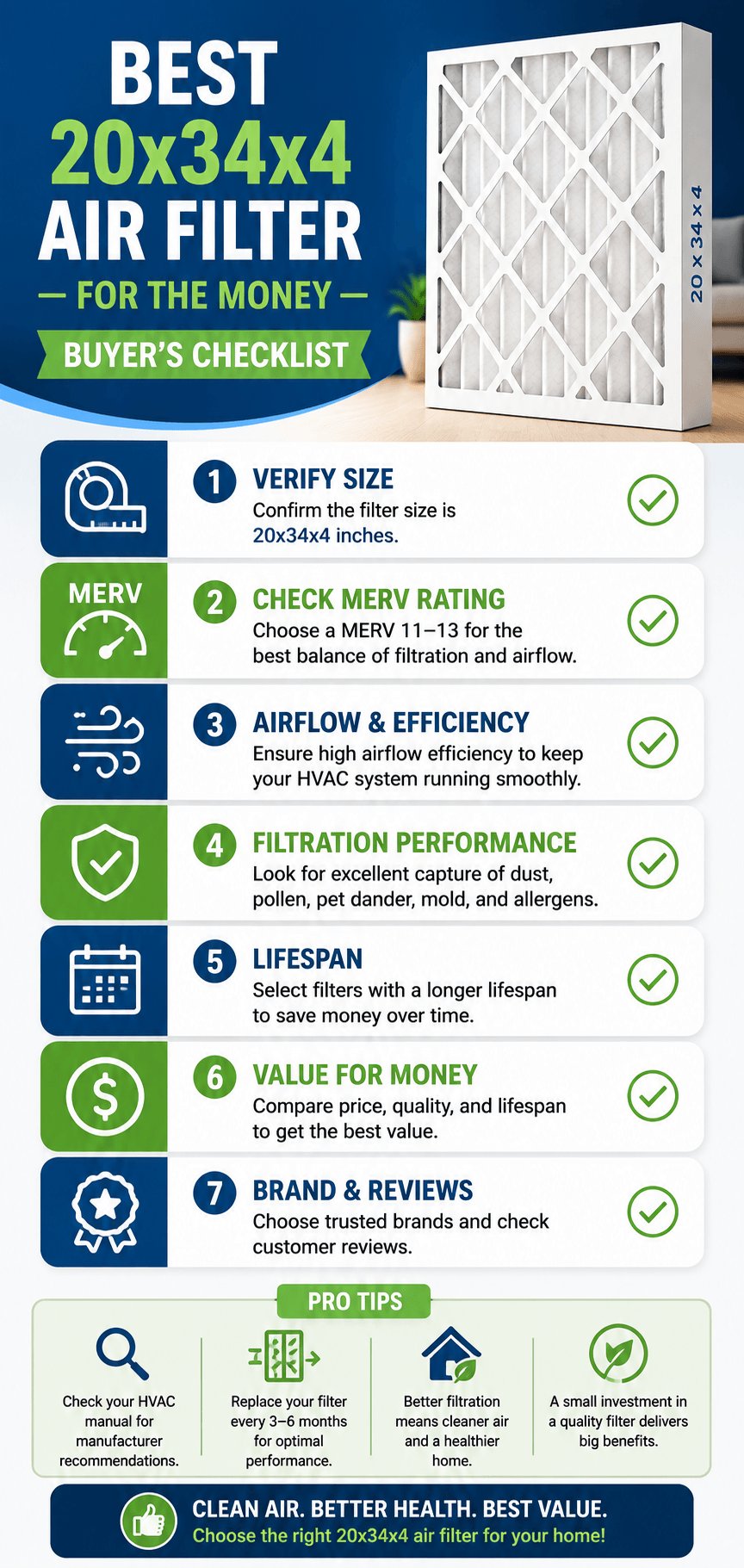
Five checks tell us whether a filter earns its money. We run them in this order.
Fit comes before features
The box says 20x34x4. The filter itself runs a little smaller, around 19.5 by 33.5 by 3.63 inches, so it drops into the slot and seats clean. What you're really checking is the seal. No gaps around the frame. Air is lazy and takes the easy path, so even a small gap lets dust slip past the media and straight into the rooms you're trying to protect. Pull your current filter, read all three numbers off the side, and confirm the depth before you buy. A 4-inch filter won't fit a 1-inch slot, and forcing it helps no one.
Match the MERV rating to the people in your home
MERV is the number that tells you how much a filter actually catches, and it's where the invisible stuff finally gets handled. For this size, we point people toward three levels. MERV 8 holds back everyday dust and lint and keeps your equipment clean. MERV 11 steps up to pet dander and mold spores, which suits most homes with animals. When someone in the house fights allergies or asthma, the strongest allergen capture comes from MERV 13, which reaches into the fine particles that carry so much of what sets off symptoms. Pick the level that matches who lives under your roof. Federal guidance backs this up, which you'll see in the numbers further down.
Buy media that lasts the full quarter
A filter only works while it has clean surface area to grab particles. Thin fiberglass loads up fast, clogs inside a few weeks, and starts making your blower fight for air. A deep-pleated filter folds far more material into the same frame, so it keeps catching and keeps breathing for the full 90 days. When we run our own load tests, the filters that go the distance all have a rigid frame, the kind that won't bow or sag when summer heat and humidity lean on it.
Do the math on a year, not one filter
The sticker price is the wrong number to shop on. A cheap filter you swap every month costs you more across twelve months than a better one that lasts a quarter, and it leaves your air dirtier the whole time. We tell people to price clean air by the day instead of by the filter. Buy a multipack or set up a refill schedule, and that daily number drops again.
Be honest about the allergy payoff
If anyone in your home deals with allergies or asthma, the rating you choose is the lever that moves symptoms. Higher-MERV media pulls more pollen, dust-mite debris, and dander out of the air in the rooms you live in. We'll be straight with you, though. A filter lowers the airborne load, and it does its best work paired with regular cleaning and keeping triggers out in the first place. In those homes, we lean toward changing the filter closer to every six weeks rather than waiting the full three months.
“I've pulled brand-new high-MERV filters out of homes where they were doing next to nothing, because they sat a hair off-size and the air slipped right around the frame. Get the size right before you fuss over the rating, and a properly sealed 20x34x4 will outwork a fancier filter every time.”
— Filterbuy Team
Seven Resources Worth Keeping
Plain guidance on matching a filter rating to your system: EPA, Guide to Air Cleaners in the Home
What's really in your indoor air, and where it comes from: EPA, The Inside Story: A Guide to Indoor Air Quality
A working plan for cutting the triggers behind asthma flare-ups: EPA, Asthma Triggers: Gain Control
How mold, dander, and pollen move through a home: EPA, Biological Pollutants and Indoor Air Quality
An allergy-first checklist for lowering indoor allergens: Asthma and Allergy Foundation of America, Control Indoor Allergens
How higher-MERV filters perform, written for builders: Building America Solution Center, High-MERV Filters
The research on indoor exposure and why filtration earns its place: EPA, Indoor Air Quality Exposure and Characterization Research
Three Numbers Worth Knowing
We spend close to 90 percent of our lives indoors, where some pollutant levels run two to five times higher than the air outside, according to the EPA. That single fact is why we treat the filter in your HVAC system as a daily air-quality tool, not an afterthought.
The EPA advises choosing a filter rated MERV 13, or as high as your system can take, and notes that filters at MERV 13 and above have to remove at least half of the smallest particles tested. The homes that step into that range are the ones where we hear the clearest difference in how the air feels.
About 8 in 10 people in the country are exposed to dust mites and 6 in 10 to cat or dog dander, per the Asthma and Allergy Foundation of America. In those homes, the rating you pick is doing the heavy lifting, since it decides how much of that load the filter pulls from the air.
Our Honest Take
If you want one straight answer, here it is. For most homes, a MERV 11 in this size is the sweet spot, with strong particle capture and airflow your system will barely notice. Move up to MERV 13 when allergies, asthma, or a chronic breathing condition is part of daily life, or when pets are. Leave the bargain fiberglass for the workshop, where all you care about is protecting the equipment. Money well spent on a 20x34x4 filter has nothing to do with chasing the top of the price range. It's the right rating, a clean seal, and a reminder you actually keep.
Frequently Asked Questions
What kind of system uses a 20x34x4 air filter?
It's a 4-inch deep size found in many home furnaces and air handlers. Read the size printed on your current filter, or measure the slot, before you order.
Is a 20x34 air filter the same as a 20x34x4?
The 20x34 is length and width. The last number is depth. A 20x34x4 runs four inches deep and won't fit a one-inch slot, so confirm all three figures every time.
What's the best MERV for allergies in this size?
We steer allergy and asthma homes to MERV 13 for its reach into fine allergen particles. The highest-rated choice for this size carries that rating.
How often should I change a 20x34x4 pleated air filter?
Plan on about 90 days for a good 4-inch filter. Pets, allergies, or a dusty home call for a tighter cycle, closer to six weeks.
Can I buy a 20x34x4 air filter near me, or order one nearby?
Local stores tend to stock common sizes and a rating or two, and a 4-inch filter this size is often missing from the shelf. Ordering online is usually the surer way to get the exact size and MERV delivered to your door.
Will a higher MERV choke my airflow?
Only if the system wasn't built for it. Most current furnaces run MERV 13 fine as long as you change the filter on schedule. If airflow feels weak, drop a level and change filters more often.
Find Your Best-Value 20x34x4 and Order With Confidence
Run the buyer's checklist against the options you're weighing, then pick the rating that fits your home and your budget. We've handed you everything you need to choose well, so match it to your household and get a fresh filter on its way.
Learn more about HVAC Care from one of our HVAC solutions branches…
Filterbuy HVAC Solutions - Weston FL
2573 Mayfair Lane Weston FL 33327
(754) 296-3528
https://maps.app.goo.gl/E3tjmKf5VSWYghGc7